.
A scientifically validated, simple, and rapid instrument for understanding how people perceive their physical, psychological, relational, spiritual, and overall well-being.
What Does It Mean to Feel Well?
When we ask someone, “How are you?”, the answer may seem straightforward. In reality, this simple question touches on a complex experience involving multiple aspects of life. We may feel physically healthy while going through a period of psychological distress. We may enjoy satisfying relationships but experience a lack of meaning or inner peace. Alternatively, we may be living with an illness and still experience moments of genuine well-being.
Well-being is not simply the absence of illness or suffering. It is a subjective, multidimensional, and dynamic experience that emerges from the interaction between physical conditions, psychological states, interpersonal relationships, and existential and spiritual dimensions.
This perspective has its roots in the World Health Organization’s definition of health and in subsequent developments in health psychology and well-being research.
But how can we assess such a complex experience in a simple, rapid, and scientifically reliable way?
The Well-being Numerical Rating Scales (WB-NRSs) were developed to address this need. This instrument was developed and validated by our research group through an international study, the results of which were published in 2021 by Andrea Bonacchi, Francesca Chiesi, and colleagues in the scientific journal PLOS ONE.
What Are the WB-NRSs?
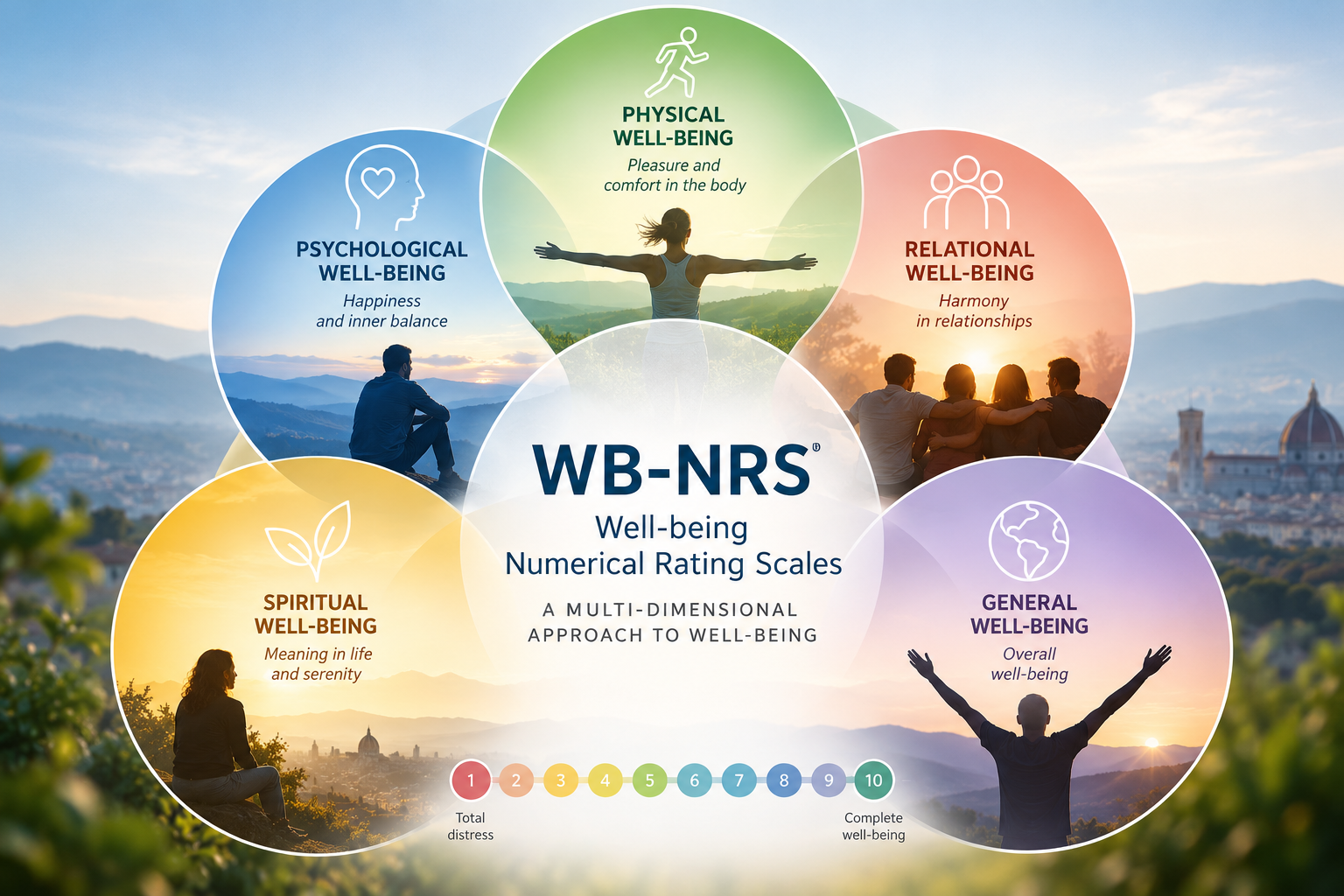
The Well-being Numerical Rating Scales consist of five numerical scales designed to assess individuals’ subjective perceptions of well-being across different areas of life.
The instrument was developed to combine two characteristics that do not always go hand in hand in psychological assessment: the ability to capture the complexity of well-being and ease of administration.
Many psychometric instruments used to assess well-being include numerous questions and require relatively long completion times. In contrast, the WB-NRSs provide a concise assessment through just five numerical responses.
Their distinctive feature lies in approaching well-being not as a single, undifferentiated phenomenon, but as the result of interactions among different dimensions of human experience.
The Five Dimensions of Well-being
1. Physical Well-being
Physical well-being concerns individuals’ subjective perceptions of their bodily condition, energy levels, physical comfort, and satisfaction of basic physiological needs.
It does not depend exclusively on the presence or absence of illness, but also on how individuals experience and perceive their physical condition.
2. Psychological Well-being
Psychological well-being encompasses the experience of positive emotions, the satisfaction of psychological needs, a sense of inner balance, and opportunities to engage in rewarding experiences.
This dimension reflects how individuals perceive their psychological functioning and the quality of their emotional experiences.
3. Relational Well-being
Relational well-being concerns the perceived quality of interpersonal relationships, the sense of belonging, opportunities to receive and provide support, and the satisfaction of social needs.
Relationships are a fundamental component of human experience and contribute significantly to overall well-being.
4. Existential and Spiritual Well-being
Existential and spiritual well-being refers to the perception of meaning, serenity, and coherence between one’s life, personal values, and existential goals.
It is important to emphasize that spiritual well-being does not necessarily coincide with religiosity.
It also encompasses secular existential aspects of human experience, such as finding meaning in life, feeling satisfied with one’s life journey, and perceiving that one is living in accordance with what one considers important.
5. General Well-being
General well-being represents an individual’s overall assessment of their state of well-being.
It is not necessarily the simple sum of the four preceding dimensions. Rather, it reflects a global evaluation in which the different components may carry varying degrees of importance depending on the individual and their circumstances.
This is particularly important: two individuals with similar physical conditions and relational circumstances may perceive different levels of general well-being.
How Do the WB-NRSs Work?
The instrument is extremely simple to use.
Individuals are asked to rate their well-being in each of the five dimensions using a numerical scale ranging from 1 to 10.
A score of 1 represents a state of absolute distress, while a score of 10 indicates a state of complete well-being.
Respondents select the number that best represents their subjective experience.
This response format offers several advantages: it is intuitive, requires minimal effort, can be administered through a written questionnaire or an interview, and allows assessments to be repeated over time.
The results provide not only an indication of general well-being but also a multidimensional profile that makes it possible to identify differences among the dimensions assessed.
For example, an individual may report a high level of relational well-being but a lower level of physical well-being. This difference may provide useful information for better understanding their experience and identifying areas that deserve further attention.
It is important to note that the scores do not, in themselves, constitute a clinical diagnosis and should be interpreted in relation to the individual’s circumstances and characteristics.
Scientific Validation: What Has Research Demonstrated?
The development and validation of the WB-NRSs were documented in the study Rapid and sound assessment of well-being within a multi-dimensional approach: The Well-being Numerical Rating Scales (WB-NRSs), published in June 2021 in PLOS ONE by Bonacchi, Chiesi, and colleagues.
The research comprised two studies involving a total of 1,568 participants.
The first study included 939 individuals from both the general population and clinical groups, including patients with cancer and liver disease.
The second study involved 629 Italian and Canadian university students and aimed to further investigate the instrument’s properties and compare the functioning of its Italian and English versions.
The researchers employed advanced psychometric methods, including Item Response Theory (IRT), to examine the scales’ ability to distinguish between individuals with different levels of well-being and to evaluate the appropriateness of the numerical response categories.
The findings provided favorable evidence regarding the instrument’s validity.
In particular, WB-NRS scores showed patterns of correlations consistent with those obtained using other well-established scientific questionnaires assessing psychological well-being, physical health, relationships, and psychological characteristics such as optimism, stress, anxiety, and depression.
The analyses also indicated that the five ratings, although referring to distinguishable aspects of individual experience, share a common underlying component of well-being.
This finding is consistent with the view that well-being is a unified phenomenon in its overall experience, while remaining differentiated in its manifestations.
An Instrument Capable of Detecting Changes
A particularly interesting aspect of the research concerns the ability of the WB-NRSs to detect changes in perceived well-being following specific experiences.
Responsiveness to change was investigated in two different settings.
In the first, hospitalized cancer patients attended live music concerts as part of the Donatori di Musica (Music Givers) initiative.
Assessments conducted before and after the concerts showed improvements in perceived general and physical well-being, accompanied by a smaller change in psychological well-being. No comparable changes were observed in relational or spiritual well-being.
In the second setting, the scales were used to assess the effects of an immersive artistic experience at the Chapel of the Magi in Palazzo Medici Riccardi, Florence, Italy.
In this case, the assessments revealed an increase in perceived general and psychological well-being.
These findings suggest that the WB-NRSs may be useful not only for describing well-being at a particular point in time, but also for observing how some of its components change in relation to specific experiences and interventions.
Naturally, changes observed before and after an activity do not, by themselves, establish a causal relationship. Nevertheless, they provide interesting evidence of the instrument’s ability to capture meaningful changes in subjective well-being.
In Which Settings Can the WB-NRSs Be Used?
The characteristics of the WB-NRSs suggest their potential usefulness across several fields of application.
In healthcare settings, they may contribute to the assessment of patients’ perceived well-being by complementing clinical information with the individual’s subjective perspective.
In psychology and psychotherapy, they may serve as a concise instrument for monitoring different components of well-being, alongside other assessment tools and clinical interviews.
In scientific research, the brevity of the scales facilitates their inclusion in research protocols involving multiple measurements or repeated assessments.
In health promotion and well-being interventions, they may be used to explore changes associated with specific programs and activities.
It is important to distinguish these potential applications from the evidence currently available: the 2021 study provides an initial and comprehensive validation, but does not automatically establish the instrument’s effectiveness in every population or setting.
Strengths of the Instrument
The main strength of the WB-NRSs lies in their combination of brevity, simplicity, and scientific foundation.
The ability to obtain five distinct ratings rapidly reduces the burden on respondents and makes the instrument particularly appealing in settings where time is limited.
Another important feature is the inclusion of a spiritual and existential dimension, which is often less represented in brief instruments assessing well-being.
Further research on the assessment of spiritual well-being and on the use of the scales in different clinical and sociocultural contexts would be valuable.
Why Is Measuring Well-being Important?
The assessment of perceived well-being has a significance that extends beyond the simple assignment of a numerical score. Measuring well-being means recognizing that an individual’s subjective experience is an important component of health and quality of life. It also means acknowledging that an assessment focused exclusively on symptoms, difficulties, or pathological conditions risks overlooking personal resources, sources of satisfaction, and positive aspects of individual experience. The WB-NRSs are grounded in this perspective: they do not seek to reduce the complexity of well-being to five numbers, but rather to provide an accessible instrument for beginning to examine it systematically.
The simplicity of measurement should not be confused with the simplicity of the phenomenon being measured.
On the contrary, a brief instrument can be particularly valuable when it is grounded in a clear theoretical model, supported by empirical evidence, and accompanied by careful interpretation of its results.
Conclusions
The Well-being Numerical Rating Scales represent a valuable contribution to the multidimensional assessment of subjective well-being.
Through five simple numerical scales, they make it possible to explore fundamental dimensions of human experience, encompassing physical, psychological, relational, spiritual, and general well-being.
The research published in PLOS ONE in 2021 provided scientific evidence supporting their psychometric properties and their ability to detect changes in well-being in specific contexts.
The perspective underlying the WB-NRSs also invites broader reflection: feeling well does not necessarily mean feeling well in every aspect of life, and overall well-being cannot be fully understood by considering only one dimension of human experience.
Having instruments capable of capturing this multidimensional nature can contribute to promoting a more person-centered understanding of health and well-being.
Download the WB-NRSs
Download the English validated version of the WB-NRSs, which may be used freely for research purposes:
Reference Article
https://doi.org/10.1371/journal.pone.0252709
For further information please contact: andreabonacchi@centrosynthesis.it