Understanding needs to understand the person
Caring for a person with cancer involves much more than diagnosis, treatment, and symptom control. Cancer can give rise to many different kinds of needs: understanding more clearly what is happening, receiving information about the future, taking part in treatment decisions, communicating more effectively with healthcare professionals, receiving psychological or emotional support, and obtaining help with practical, relational, or financial difficulties.
Some of these needs are adequately addressed during the care process, while others remain unanswered. These are commonly referred to as unmet needs. An unmet need can be understood as the gap between the level of support or care a person receives and the level that he or she perceives as necessary to achieve the best possible physical, psychological, and social well-being.
Assessing unmet needs is therefore an important component of patient-centred care.
Why assess unmet needs?
Assessing unmet needs can serve several purposes.
At the individual patient level, it can help healthcare professionals identify specific problems that might otherwise remain unexpressed—for example, a need for additional information about diagnosis or treatment, better symptom control, psychological support, or help with practical difficulties.
At the level of groups of patients, the assessment of unmet needs can identify recurrent problems associated with particular clinical or sociodemographic characteristics and can therefore contribute to the development of more appropriate healthcare services and interventions.
Finally, at the healthcare-system level, information about unmet needs can help healthcare planners and policymakers allocate available resources to those areas where needs are greatest and most urgent.
This is particularly important because patients do not always spontaneously communicate their concerns to healthcare professionals, especially when these involve psychological, emotional, relational, or social issues.
The Needs Evaluation Questionnaire
Clinical interviews are essential for understanding patients’ needs, but standardized questionnaires can provide an additional means of systematically identifying problems that might otherwise remain unrecognized.
The Needs Evaluation Questionnaire (NEQ) was developed by Marcello Tamburini and colleagues at the Istituto Nazionale Tumori in Milan to assess unmet needs among patients with cancer, initially in the hospital setting.
The NEQ is a brief, self-administered questionnaire consisting of 23 dichotomous items, with YES/NO responses. An affirmative response indicates that the patient perceives the corresponding need as currently unmet.
Its main strengths are its brevity, simplicity, and ease of administration, making it suitable both for clinical practice and for research. The original studies conducted by Tamburini and colleagues demonstrated the usefulness of the questionnaire for systematically describing the needs reported by hospitalized patients with cancer.
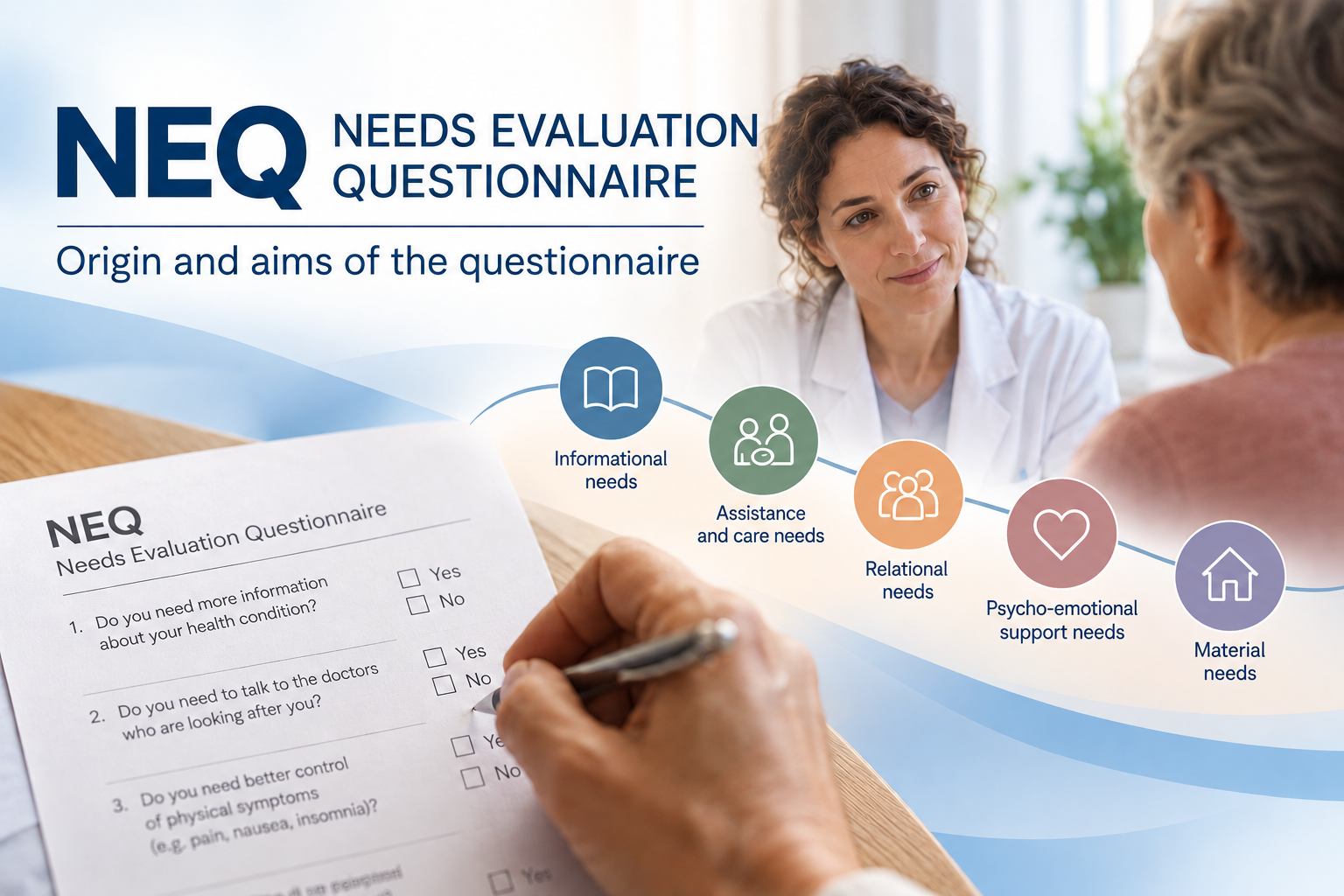
Subsequent psychometric research further investigated its structure. Using factor analysis, Annunziata, Muzzatti and Altoè (2009) identified five broad dimensions of unmet needs:
- informational needs;
- assistance/care needs;
- relational needs;
- psycho-emotional support needs;
- material needs.
The NEQ should nevertheless not be regarded merely as a numerical scale. From a clinical perspective, each individual YES response is important because it identifies a specific need expressed directly by the patient.
From research to clinical practice
One of the most useful features of the NEQ is that it allows the patient’s perspective to be incorporated directly into the care process. Rather than assuming what a patient might need on the basis of diagnosis, age, disease stage, or the healthcare professional’s own clinical impression, the questionnaire asks the person directly.
A simple question such as:
“Do you need more information about your future condition?”
or
“Do you need to talk to a psychologist?”
can reveal a problem that may never have emerged spontaneously during a clinical consultation.
In this sense, the NEQ is not intended to replace the relationship between the patient and healthcare professionals. On the contrary, it can provide a starting point for dialogue.
The questionnaire can help identify what matters to the person at a particular moment and make it possible to explore the need more fully during the clinical encounter.
Beyond the hospital setting
The original NEQ was developed by Tamburini and colleagues for patients with cancer receiving inpatient hospital care.
However, cancer care has progressively shifted beyond the traditional hospital ward. Many patients now receive treatment in day hospitals and outpatient clinics and are followed for long periods through follow-up and rehabilitation programmes.
Research conducted by our group subsequently investigated the use of the NEQ in these settings, demonstrating its applicability to cancer outpatients as well. This work also led to the development of an extended version specifically designed to take into account needs that may become particularly relevant outside the inpatient setting.
A questionnaire that gives patients a voice
The fundamental idea underlying the NEQ is simple: the needs of a patient should not be inferred solely from the clinical condition—they should also be directly assessed by asking the patient.
Two people with the same diagnosis and at the same stage of disease may have very different needs. One may primarily need clearer information about treatment, another psychological support, another help with practical or financial difficulties, and another simply greater opportunity for dialogue with healthcare professionals. For this reason, assessing unmet needs contributes to a more individualized approach to care.
The NEQ provides a structured way of listening to the patient’s perspective and of translating that perspective into information that can be useful for clinical care, research, healthcare service planning, and the evaluation of quality of care.
Download the English version of the 23-item NEQ validated for use with hospitalized cancer patients:
For more information and contacts: andreabonacchi@centrosynthesis.it
References
Annunziata MA, Muzzatti B, Altoè G. A contribution to the validation of the Needs Evaluation Questionnaire (NEQ): a study in the Italian context. Psycho-Oncology. 2009;18(5):549–553.
Baum M. What are the needs of patients diagnosed with cancer? Psycho-Oncology. 2004;13:850–852.
Bonacchi A, Rossi A, Bellotti L, Franco S, Toccafondi A, Miccinesi G, Rosselli M. Assessment of psychological distress in cancer patients: a pivotal role for clinical interview. Psycho-Oncology. 2010;19:1294–1302.
Bonacchi A, Toccafondi A, Mambrini A, Cantore M, Muraca MG, Focardi F, Lippi D, Miccinesi G. Complementary needs behind complementary therapies in cancer patients. Psycho-Oncology. 2015;24(9):1124–1130. doi:10.1002/pon.3773.
Carey M, Lambert S, Smits R, Paul C, Sanson-Fisher R, Clinton-McHarg T. The unfulfilled promise: a systematic review of interventions to reduce the unmet supportive care needs of cancer patients. Supportive Care in Cancer. 2012;20(2):207–219.
Cassileth BR, Zupkis RV, Sutton-Smith K, March V. Information and participation preferences among cancer patients. Annals of Internal Medicine. 1980;92(6):832–836.
Clavarino AM, Lowe JB, Carmont SA, Balanda K. The needs of cancer patients and their families from rural and remote areas of Queensland. Australian Journal of Rural Health. 2002;10(4):188–195.
Davis C, Williams P, Redman S, White K, King E. Assessing the practical and psychosocial needs of rural women with early breast cancer in Australia. Social Work in Health Care. 2003;36(3):25–36.
Fitch M. Supportive care for cancer patients. Hospital Quarterly. 2000;3(4):39–46.
Girgis A, Boyes A, Sanson-Fisher RW, Burrows S. Perceived needs of women diagnosed with breast cancer: rural versus urban location. Australian and New Zealand Journal of Public Health. 2000;24(2):166–173.
Harrison JD, Young JM, Price MA, Butow PN, Solomon MJ. What are the unmet supportive care needs of people with cancer? A systematic review. Supportive Care in Cancer. 2009;17(8):1117–1128.
Richardson A, Medina J, Brown V, Sitzia J. Patients’ needs assessment in cancer care: a review of assessment tools. Supportive Care in Cancer. 2007;15(10):1125–1144.
Sanson-Fisher R, Girgis A, Boyes A, Bonevski B, Burton L, Cook P. The unmet supportive care needs of patients with cancer. Cancer. 2000;88(1):226–237.
Tamburini M, Gangeri L, Brunelli C, Beltrami E, Boeri P, Borreani C, Fusco Karmann C, Greco M, Miccinesi G, Murru L, Trimigno P. Assessment of hospitalised cancer patients’ needs by the Needs Evaluation Questionnaire. Annals of Oncology. 2000;11(1):31–37.
Tamburini M, Gangeri L, Brunelli C, Boeri P, Borreani C, Bosisio M, Karmann CF, Greco M, Miccinesi G, Murru L, Trimigno P. Cancer patients’ needs during hospitalisation: a quantitative and qualitative study. BMC Cancer. 2003;3:12.