The Needs Evaluation Questionnaire (NEQ) is a self-administered questionnaire consisting of 23 dichotomous items, designed to assess unmet needs in patients with cancer. The items explore five areas: informational needs, assistance and care needs, relational needs, psycho-emotional support needs, and material needs.
Each item has a dichotomous response format:
NO = 0
YES = 1
A YES response indicates that the patient reports the need described by the item and perceives that need as not being adequately met.
NEQ interpretation can be organized at three levels, each serving a different purpose.
1. Individual-item interpretation – the primary level for clinical use
In clinical practice, the individual item represents the primary level of NEQ interpretation.
Each affirmative response identifies a specific need directly reported by the patient. A need does not have to occur alongside several other needs, nor does a particular threshold have to be exceeded, for it to be clinically relevant.
Therefore: Each “YES” response should be regarded as a potentially relevant unmet need that may warrant attention, further exploration and, when appropriate, a specific care response.
This principle is particularly important because the NEQ was developed to capture the patient’s own perspective. Consequently, a low total, domain, or scale score should not lead clinicians to overlook a single positive item that may be clinically important.
For example, a patient may answer “NO” to 22 items but “YES” to the need for better symptom control, the need to talk to a psychologist, or the need for more information about their future condition. That single need retains its clinical significance regardless of the overall score.
From a clinical perspective, the NEQ can also be used as a tool to facilitate the clinical dialogue, helping healthcare professionals identify issues that should be explored in greater depth with the patient.
2. Domain scores – primarily for research use
For research purposes, responses to the items belonging to each of the five NEQ domains can be summarized.
The domain score can be calculated as the proportion of affirmative responses among the validly answered items within that specific domain:
NEQ domain score = Number of YES responses in the domain / Number of validly answered items in the domain
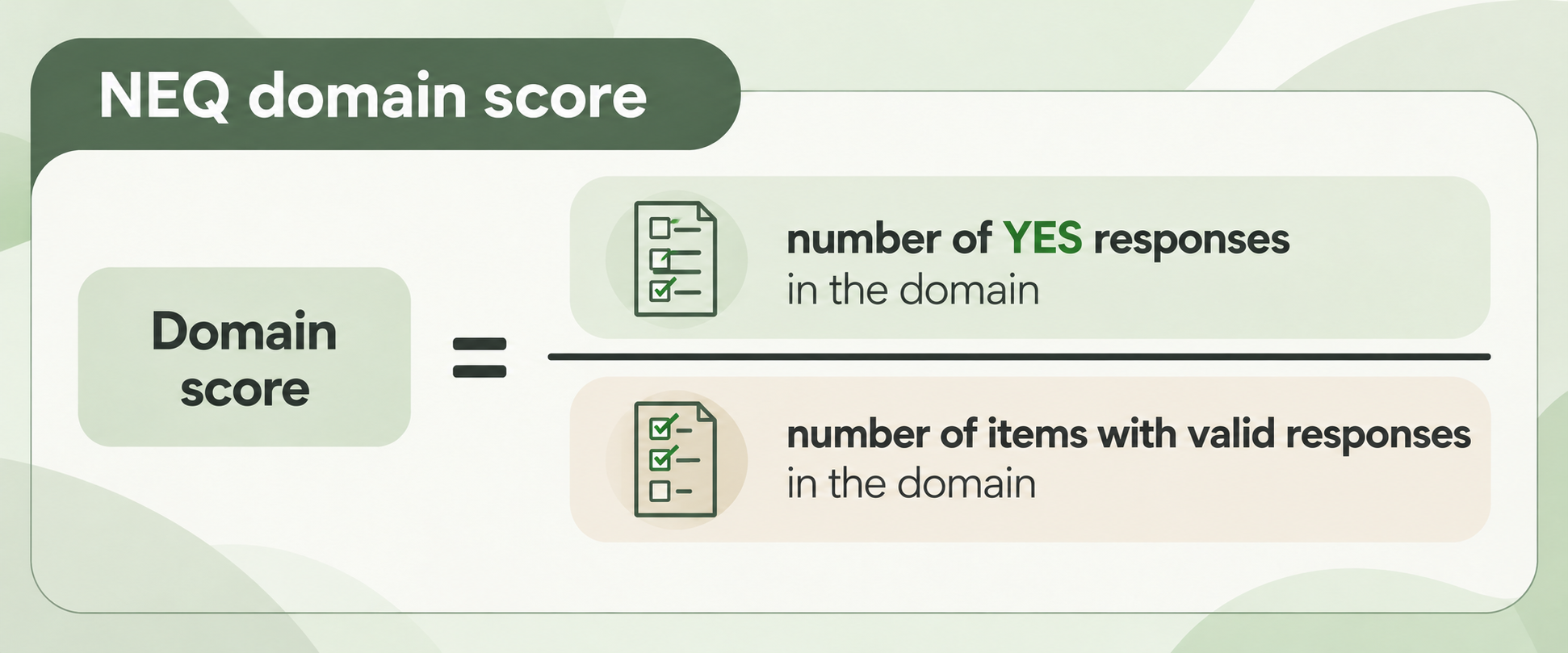
The score therefore ranges from 0 to 1, with higher values indicating a greater proportion of unmet needs within the domain considered.
Scores for the different domains can be used to describe a patient’s profile of unmet needs and are particularly useful for comparing groups of patients, healthcare settings, phases of the disease, or assessments conducted at different time points.
It is important to remember that the domains contain different numbers of items. Therefore, when comparing domains with one another, it is preferable to use proportions rather than simply comparing the absolute number of affirmative responses.
The items included in each domain are shown below:
| NEQ domain | Items | No. of items |
|---|---|---|
| Informational needs | 1, 2, 3, 4, 5, 6, 7, 8, 13 | 9 |
| Assistance and care needs | 10, 11, 12 | 3 |
| Relational needs | 20, 21, 22, 23 | 4 |
| Psycho-emotional support needs | 17, 18, 19 | 3 |
| Material needs | 14, 15, 16 | 3 |
Note: Item 9, concerning the need for better symptom control, is not included in the five subscales of the 22-item factorial model. However, it remains part of the 23-item NEQ and should be considered both in individual clinical interpretation and in the overall NEQ score.
3. Overall NEQ score – primarily for research use
For research purposes, the overall extent of unmet needs can be expressed as the proportion of affirmative responses across all validly answered items:
Overall NEQ score = Total number of YES responses / Total number of validly answered items
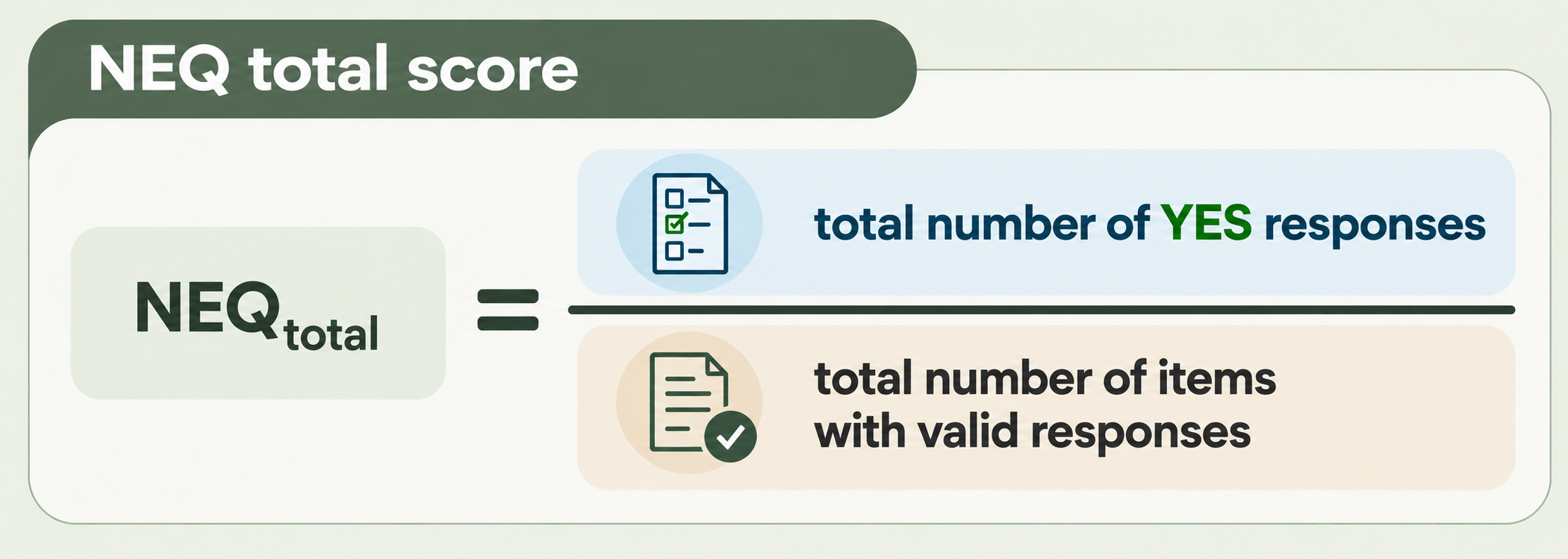
The score ranges from 0 to 1:
- 0 = no unmet needs identified;
- 1 = an affirmative response to all validly answered items;
- higher values indicate a greater overall proportion of unmet needs.
For example, if a patient answers all 23 items and gives 8 affirmative responses:
Overall NEQ score = 8 / 23 = 0.35
Conclusions
In clinical use of the NEQ, particular attention should be paid to the presence of specific unmet needs, each of which may require a targeted response from healthcare professionals.
In research, domain and overall scores can instead be used to quantify and compare the extent of unmet needs.
Based on the evidence currently available for this scoring guide, clinical cut-off values should not be defined to classify patients as having “low,” “moderate,” or “high” levels of unmet needs.
The NEQ should therefore not be interpreted according to a diagnostic rule such as:
Total number of reported needs ≥ X = patient with clinically significant needs
Instead, interpretation should follow a simple hierarchy:
Individual item → Domain → Overall score
The individual item remains the primary source of clinically actionable information, while domain and overall scores provide complementary summary measures that are particularly useful for research.
This approach preserves the original principle underlying the NEQ: to provide a tool that supports patient-centred care and a patient-centred therapeutic relationship.
For further information or enquiries: andreabonacchi@centrosynthesis.it
References
Annunziata MA, Muzzatti B, Altoè G. A contribution to the validation of the Needs Evaluation Questionnaire (NEQ): a study in the Italian context. Psycho-Oncology. 2009;18(5):549–553.
Bonacchi A, Toccafondi A, Mambrini A, Cantore M, Muraca MG, Focardi F, Lippi D, Miccinesi G. Complementary needs behind complementary therapies in cancer patients. Psycho-Oncology. 2015;24(9):1124–1130. doi:10.1002/pon.3773.
Bonacchi A, Di Miceli S, Lippi D, Muraca MG, Miccinesi G. Unmet needs of Italian cancer patients in different stages of the disease and care process. Tumori Journal. 2018;104(4):285–291. DOI: 10.5301/tj.5000637.
Bonacchi A, Fazzini E, Messina S, Muraca MG, Pacetti P, Di Miceli S, Miccinesi G. Sociodemographic, clinical, and psychological characteristics identify groups of Italian cancer patients with high rates of unmet needs. Tumori Journal. 2019;105(4):288–295. DOI: 10.1177/0300891618792458.
Chiesi, F., Bonacchi, A., Primi, C., & Miccinesi, G. (2017). Assessing unmet needs in patients with cancer: An investigation of differential item functioning of the Needs Evaluation Questionnaire across gender, age and phase of the disease. PLOS ONE, 12(7), Article e0179765. https://doi.org/10.1371/journal.pone.0179765
Tamburini M, Gangeri L, Brunelli C, Beltrami E, Boeri P, Borreani C, Fusco Karmann C, Greco M, Miccinesi G, Murru L, Trimigno P. Assessment of hospitalised cancer patients’ needs by the Needs Evaluation Questionnaire. Annals of Oncology. 2000;11(1):31–37.
Tamburini M, Gangeri L, Brunelli C, Boeri P, Borreani C, Bosisio M, Karmann CF, Greco M, Miccinesi G, Murru L, Trimigno P. Cancer patients’ needs during hospitalisation: a quantitative and qualitative study. BMC Cancer. 2003;3:12.