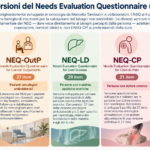
NEEDS EVALUATION QUESTIONNAIRE (NEQ) – Questionnaire Versions and Their Uses
Originally developed for oncology by Marcello Tamburini and colleagues, the NEQ has gradually evolved into a family of instruments for assessing unmet needs. Its different versions preserve the fundamental principle of the NEQ—giving people a direct voice in expressing their perceived needs—while adapting it to different populations and clinical settings and, with the NEQ-OP, to […]
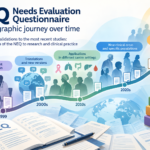
Needs Evaluation Questionnaire (NEQ): Chronological Bibliography
. The following scientific publications report the use of the Needs Evaluation Questionnaire: 2000 — Development and initial validation of the oncology NEQ Tamburini M, Gangeri L, Brunelli C, Beltrami E, Boeri P, Borreani C, Fusco Karmann C, Greco M, Miccinesi G, Murru L, Trimigno P. Assessment of hospitalised cancer patients’ needs by the Needs […]

NEEDS EVALUATION QUESTIONNAIRE FOR CANCER OUTPATIENTS (NEQ-OutP) Development of a 27-item questionnaire for patients receiving cancer care in day hospital, outpatient, and rehabilitation settings
Cancer care beyond inpatient treatment The Needs Evaluation Questionnaire (NEQ) was originally developed by Marcello Tamburini and colleagues at the Istituto Nazionale Tumori in Milan to assess the unmet needs of hospitalised patients with cancer. It is a brief instrument comprising 23 items with dichotomous responses, designed for straightforward use in both clinical practice and […]

NEEDS EVALUATION QUESTIONNAIRE (NEQ): Unmet Needs in Oncology Vary Across Stages of Illness and Care and According to Individual Characteristics
The needs of people living with cancer are not necessarily the same for everyone, nor do they remain unchanged throughout the care pathway. Information, communication with healthcare professionals, psychological support, care and assistance, and material difficulties may take on different levels of importance depending on the stage of illness and individual characteristics. Two studies by […]

NEEDS EVALUATION QUESTIONNAIRE (NEQ) – Cancer Patients’ Informational Needs: Can We Identify Who Needs More Information?
Information is a fundamental component of cancer care. Knowing one’s diagnosis, understanding treatments, knowing which tests will be needed, and being able to discuss the future enable people to participate more fully in decisions about their health. Yet receiving information does not necessarily mean feeling sufficiently informed. And, crucially, can clinicians recognise which patients feel […]

Complementary Needs Behind Complementary Therapies in Cancer Patients: What the NEQ Reveals
When a person living with cancer turns to complementary therapies, what needs are they seeking to address? The search for greater well-being may be accompanied by a desire to better understand their treatment, communicate more effectively with healthcare professionals, or feel more actively involved in their care.This question guided our study, “Complementary needs behind complementary […]

APPUNTI DI VIAGGIO SU UN TEMPIO TRACE
di Patrizio Caini biologo, ricercatore, analista comportamentale, giornalista pubblicista Per la rubrica:Curiosità e misteri nel mondo della psicologia, antropologia e spiritualitàScheda del Introduzione Nel mese di luglio del 2025, l’autore si è recato per la seconda volta in Bulgaria (la prima volta fu nel 2012), paese che ama particolarmente. L’obiettivo era quello di approfondire sul […]

CARE ACADEMY 2026 – “L’Elefante Invisibile – Dialoghi sulla complessità e sulla diversità”
Care Academy è una scuola speciale dedicata alla “relazione” pensata specialmente (manon solo) per tutti i professionisti e volontari della Relazione di Aiuto che voglionomigliorare il modo in cui si relazionano con le persone che assistono, e per tutti coloro chevogliono approfondire gli argomenti proposti. L’edizione 2026 prevede 4 seminari esperienziali, Ciò che rende speciale […]

COSA POSSIAMO IMPARARE DALL’INCONTRO TRA CULTURE – appunti del seminario del 10 Gennaio 2026 – Erika Agresti e Paolo Assandri
Cosa possiamo imparare dell’incontro tra culture: appunti del seminario del 10 Gennaio 2026. Viviamo in una società in cui la dimensione interculturale non è più un’ipotesi astratta, ma una realtà quotidiana. Lo vediamo nelle scuole, nei servizi sociali, negli ambulatori, nei luoghi di lavoro. Sempre più spesso incontriamo persone con storie, lingue e riferimenti culturali […]